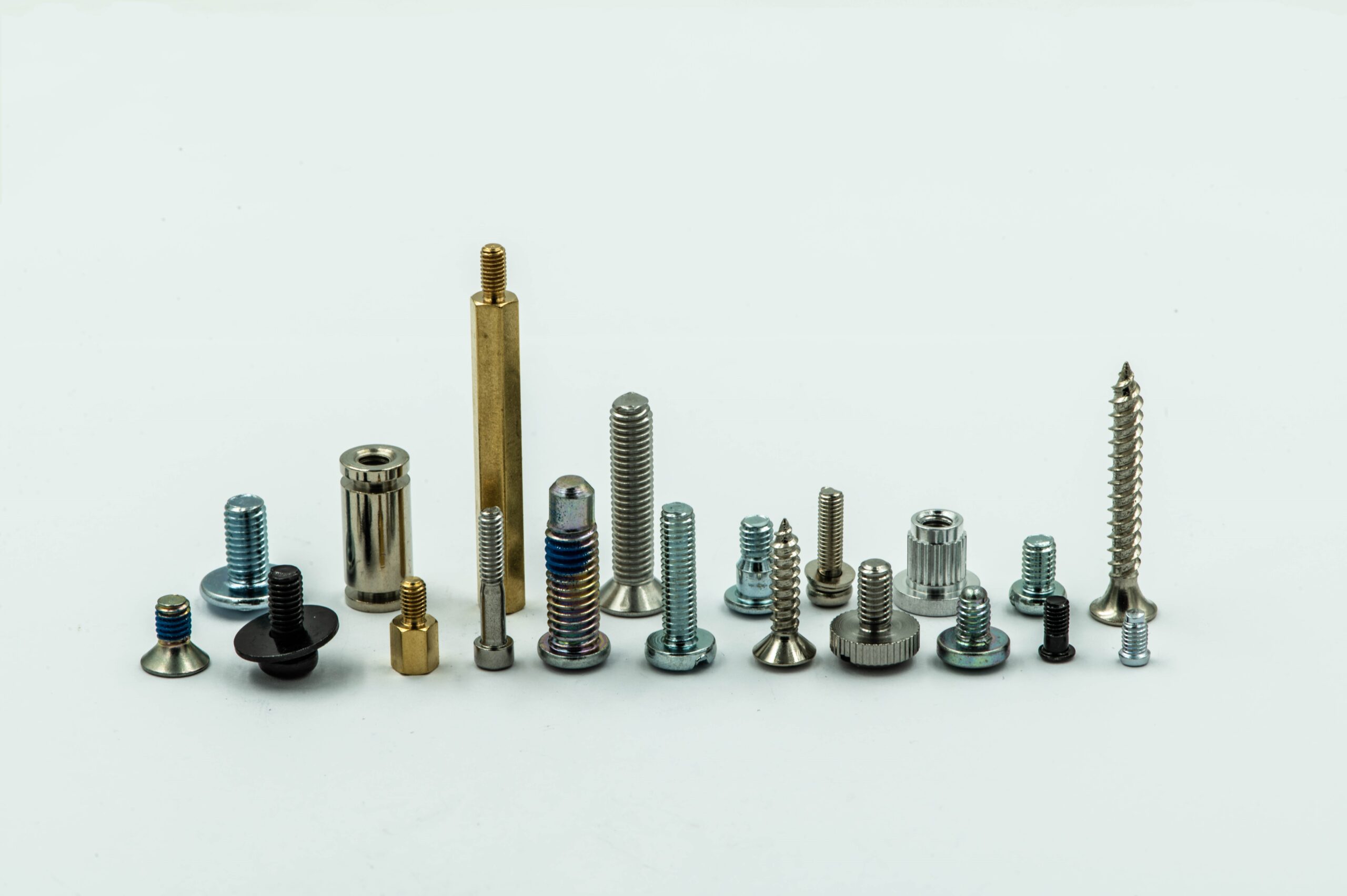
The fastener market encompasses a wide range of products used to securely connect two or more parts together. The primary categories of fasteners include:
- Bolts: Used to fasten materials together through a nut or directly into a threaded hole.
- Screws: Similar to bolts but typically have a smaller head and are designed to be inserted and tightened or removed with a screwdriver.
- Nuts: Used in conjunction with bolts to provide a threaded connection.
- Washers: Flat, thin disks placed between a nut, bolt, or screw and the surface being fastened, serving to distribute pressure and prevent leakage.
- Rivets: Permanent fasteners that are inserted into a hole and deformed to hold two pieces of material together.
- Pins and Dowels: Used to align and locate parts or to transmit forces.
- Threaded Inserts: Used to provide a threaded hole in a material that does not have one naturally.
- Self-Tapping Screws: Designed to create their own threads as they are screwed into a material.
Standards in the Fastener Market:
Fasteners are subject to various standards that define their dimensions, materials, mechanical properties, and performance requirements. Some of the most commonly used standards include:
- International Organization for Standardization (ISO): Sets global standards for fasteners, such as ISO 4014 for hexagon socket head cap screws and ISO 4032 for hexagon nuts.
- American Society of Mechanical Engineers (ASME): Develops standards for fasteners used in the United States, such as ASME B18.2.1 for hexagon nuts.
- American National Standards Institute (ANSI): Also contributes to fastener standards, collaborating with other organizations like ASME.
- Deutsches Institut für Normung (DIN): Sets standards for fasteners in Germany and is widely recognized internationally.
- Japanese Industrial Standards (JIS): Defines standards for fasteners used in Japan.
In addition, many countries have their own national standards for fasteners, such as the Chinese National Standards (GB) and the British Standards Institution (BSI) standards in the United Kingdom.
Standard vs. Non-Standard Fasteners:
-
Standard Fasteners (Standard Parts): These are fasteners that conform to established standards such as ISO, ASME, DIN, JIS, or national standards. They are widely available, interchangeable, and can be sourced from multiple manufacturers. Standard fasteners include bolts, nuts, screws, washers, and other commonly used types.
-
Non-Standard Fasteners (Non-Standard Parts): These are fasteners that do not conform to any established standard. They are typically designed and manufactured to meet specific customer requirements or applications. Non-standard fasteners can include custom sizes, threads, materials, or coatings. They are often more expensive and have longer lead times than standard fasteners due to the need for custom manufacturing.
In summary, the fastener market encompasses a diverse range of products, including bolts, screws, nuts, washers, and more, that are subject to various international and national standards. Standard fasteners are widely available and interchangeable, while non-standard fasteners are designed to meet specific requirements.